Friday, October 31, 2008

Maitri American Style


A story of friendship in a new land

There was something strange in the water.

At least that was what Kusum-Tai Karmarkar thought as she took a long drink from the glass of pani the flight attendant brought her.

Sitting aboard the Czechoslovakian Airlines flight bound from Mumbai, India to Chicago, so many worries poured through her mind: Will we reach there or not? How will my sons pick up the language? Am I better off in India or America?

Again she sipped her water. Again the bubbles floated up and out her nose, prompting her to wonder if all the water in America was fizzy and sour tasting like this.

How will I cook with this strange water? How will I make chai?

Eventually, the misunderstanding became clear – Kusum-Tai had her first taste of carbonated water and her first taste of the difficulties that lay ahead.

That was 37 years ago. Today, watching this sprite, energetic woman prepare a vegetable bhaji in her modern, sunlit kitchen, it is hard to imagine that she and her family left India with all their possessions stuffed into a few suitcases. Layered between her favorite saris were her jewelry, clothing for the kids and – most important – her rolling pin to make the flatbread called chapatti, the staple of every Indian meal.

“Leaving my family and friends in India was real hard because we have a close family from both sides,” Kusum-Tai recalls, as she brushes back a wisp of silver hair that has escaped from her clip.

“I was worried about my kids because they used to talk in our mother tongue – Marathi. My English I learned in the school but I don’t know how to do conversation. Sushil has had one subject in English from 5th to 8th grade. But Subodh does not speak a word of English.”

Like thousands of Indian families in the 1970s, Kusum-Tai and her husband Vasudeo moved to America in search of prosperity and opportunities that were not possible in India. The 1965 Immigration and Nationality Act, which reversed decades of restrictive immigration policies, resulted in unprecedented numbers of new arrivals in this country, particularly from South Asia.

Between 1971, the year Kusum-Tai and her family arrived, and 2002, more than 1 million Indians were admitted to the United States. Most applied for permanent resident status and eventually became U.S. citizens. Their presence has contributed to the development of Asian enclaves in several major cities, where these new citizens learned to assimilate into American culture while still retaining a strong sense of their Indian identity. Kusum-Tai’s family was one of the first Indian families to settle in suburban Chicago. For them, this meant literally building a community from the ground up.

Since settling here, Kusum-Tai has accomplished things she never dreamed of when she left India: She earned her drivers’ license and her American citizenship. Twice, she started her own business. She and Vasudeo were able to send their older son to medical school – he is now a cardiologist in the Bay Area. Their younger son is the CEO of a company. How did she do it? For Kusum-Tai, the solution to all life’s challenges has been: ‘with a little help from my friends’.

“I am so lucky!” Kusum-Tai exclaims, clapping her hands together for emphasis. “Right from the beginning I always made friends. That’s why I learn from them so many times and they learn from me also.”

Pradnya Ambekar, who lived nearby, became Kusum-Tai’s first friend in America. She remembers that Kusum-Tai’s loving, helping and happy nature was the catalyst that propelled their friendship into a close relationship.

“I was newly married and Kusum-Tai had been married for some time. She helped me settle into a family life while living in the U.S. I helped her to become “Americanized” while still being Indian,” Pradnya remembers. “Kusum-Tai taught me to cook many Indian delicacies while I got her out on her first temporary job.”

Kusum-Tai had never worked in India. She had not learned to drive and was worried about her limited English skills. With help from Pradnya, she found a temporary clerical job at the company where Pradnya had worked for several years. Each morning, Pradnya picked up Kusum-Tai at her apartment and they drove to work.

“The first job was easy because Pradnya was always there and everybody knows her,” Kusum-Tai recounts. “She told them, ‘Kusum-Tai is new in America and if she does not understand what you are saying, come to me and I will explain to her and then she will do it.’ And then my fear of how to speak with American people was gone.”

In the 1970s, it was common for Indians emigrating to the U.S. to have a sponsor – a person already living in this country who could help the new arrival become established. For Vasudeo and Kusum-Tai, that person was her maternal cousin, Shekhar, whom she considers a brother.

Shekhar and his wife, Mohini, lived in a high-rise apartment building on Lake Shore Drive in Chicago. A broad smile lights Kusum-Tai’s face as she remembers how her sons Sushil and Subodh clamored to do the laundry so they could ride the elevator down 19 floors to the laundry room and back up again.

“Up and down, up and down,” she laughs, her brown eyes sparkling behind oval-rimmed glasses. “For one month we lived in their apartment. Mohini showed me everything. How to put the coin inside the washer and dryer, how to go to the bank. At that time there were no Indian shops. There was a Dominick’s store where we used to buy whole wheat flour for chapatti.”

Wherever Mohini went, Kusum-Tai went too and she quickly learned the skills she needed to survive.

“Without Shekhar and Mohini it was really hard for us to settle down in this country,” she says. “My brother’s heart was so big that we never forget about him. After a week [on his new job] my husband got his paycheck and Shekhar put the down payment and then he bought a car for us. They did so much. If we need money they will give it immediately. Without questioning.”

Within a month, Kusum-Tai and her family moved to their own apartment in the Chicago suburb of Wheaton. The boys learned English in summer school and the family established themselves in their new home, building a tightly-knit community as more and more Indian families settled in the area.

Kusum-Tai had already been married 15 years when she came to this country, so she quickly became like an older sister to the new Indian brides who arrived in the community. When she heard about a new family, she promptly invited them for a meal, doling out marital advice and recipes alongside the khichadi she served for dinner.

Kusum-Tai and Pradnya soon formed a group of five Indian women - “a ladies’ club” - who planned many events during their first few years in America. Every Friday, they gathered for a potluck supper at one of their homes. They celebrated birthdays, anniversaries and Hindu holidays. They organized baby showers, called Dohaljevan.

Kusum-Tai threw herself into entertaining. From morning to night, the sharp, pungent aroma of golden-hued daals and masalas filled their tiny apartment. In those days, Indian staples and spices were difficult to obtain so Kusum-Tai decided to help the Indian community by starting a small Indian grocery from her home.

Once a month, Vasudeo and Kusum-Tai drove 50 miles to the north side of Chicago to purchase her groceries in bulk. When customers came to her home, they were treated like rajas with tea and freshly-made snacks. The problem was that they were treated so well, the profits were devoured! The business didn’t last long but the friendships flourished.

The year after Kusum-Tai and her family moved to America, they sponsored Suhas Athalye, a fellow-Indian from their hometown of Pune, who lived with them for seven months. When Suhas found a job, he sent for his new wife, Jaya, who formed an instant bond with Kusum-Tai.

“She was my teacher!” Jaya exclaims when she describes her friend. “She taught me everything – religious things, cooking. She was like an older sister.”
When Jaya had her first puja (Hindu blessing ceremony), Kusum-Tai brought her own pots and pans and cooked all day. When Jaya had her first child, Kusum-Tai showed her how to bathe the baby. “She is very loving, very kind,” Jaya says, “she won’t do for herself but she will do for everybody else.”

Kusum-Tai is quick to shrug off compliments. “That’s the way we (Indians) do. Helping each other always.”

America has left its impression on Kusum-Tai. But more significant is the indelible mark the community she helped build has left on this country. From Bollywood to Bhangra dance, Indian culture has become part of mainstream America.

The friends she made during her early years in Chicago are now scattered across the country, but she keeps in touch with weekly phone calls and e-mail. Though she claims to have scaled back on entertaining, Kusum-Tai is still happiest in her kitchen, preparing meals for friends and family, childhood pals from India, visiting swamis and long-lost relatives who appear at her door. Her heart and her home are always open.

“Friendship always comes from the stomach!” she says with pride.

That mantra continues to serve her, and her many friends, well.

Friday, July 4, 2008

The Eggplant Rebellion


Here is a view on life from the perspective of one of my favorite vegetables.

Hey, it’s me, the Eggplant. I’ve been hanging out here at the Fullerton Farmers’ Market all afternoon and, man, do I have a beef with you veggie-buyers. I’m sick and tired of being treated like a second-class vegetable! When will I get the respect I deserve?

Today, things finally came to a head. Farmer Juan unloaded me way down at the end of his table, squashed between the zucchini and the butternut so nobody could see me. Of course, the Avocado got a prime location, hogging center stage as usual.

Look at him over there, that pompous Hass. What a show off! I wonder whose rind he had to kiss to get that spot. And now that cherry season started, my life has really become the pits. I might as well be invisible!

Finally, around five o’clock I spied a customer giving me ‘the look’. “Pick me! Pick me!” I shouted. And she did. She picked and she pinched. She poked, prodded, plied and picked some more. Then she turned to her husband and said, “That’s the tiniest eggplant I’ve ever seen!”

Now that’s getting rather personal, don’t you think?

Don’t you people realize that eggplants have feelings too? I’ve had it up to my hairy little stem with your rude comments as you walk by: “It doesn’t look good. I wouldn’t eat it,” and “You have to disguise the taste with lots of fat and cheese.” 


Honey, I don’t go around shouting to the world that you look like a stuffed bratwurst in those skin-tight Daisy Dukes you poured yourself into. Down on the farm, we’re taught to treat other vegetables with kindness and respect.

And speaking of the farm, if you knew what I’ve gone through to get here today, maybe you would have a little more sympathy. I’ve spent the past three months buried up to my keister in dirt on a farm near Fresno. Fresno is not exactly the garden spot of the nation, you know.


And if that isn’t bad enough, imagine having to contend with 1000 siblings - that’s how many eggplants Farmer Juan plants every spring. It’s pretty hard to get attention when you have that kind of competition.

Is it any wonder I’m having an identity crisis?

Those days and nights in the ground were sheer hell. I spent my formative weeks fighting off diseases like Black Mold Rot, Cottony Leak and Phomosis Rot. And those are just the ones I can pronounce. I was constantly attacked by pests - the flea beetles, aphids and spider mites love my succulent flesh. At least somebody does.

On harvest day, I was unceremoniously snipped from my vine and tossed in a dark, damp carton with 29 eggplant brothers and sisters. Then I spent four miserable hours jolted and jostled on the back of a pickup truck. By the time we reached Fullerton, my innards had turned to mush! Do the words ‘eggplant smoothie’ mean anything to you?

Finally, we got to the market and what does Farmer Juan do? He dumps me on the table in full sunlight! Doesn’t he realize how sensitive my skin is to the sun? A couple more hours of this and I’m a goner!

I guess I’m just destined to be misunderstood. Earlier, I overheard a lady tell her friend that she tried eggplant once and liked my flavor but she wasn’t sure how to cook me. “Ratatouille!” I nearly screamed. “Moussaka! Caponata!” I’m also lovely brushed with oil, grilled for five minutes per side and paired with a chilled Chardonnay.

If people would take the time to get to know me, they would discover there is more to eggplant than just Parmesan. For instance, I’ll bet you didn’t know that I am actually not a vegetable at all – I’m a fruit! That’s right, I’m a member of the berry family, closely related to the tomato and potato.

And here’s a little-known fact: Eggplants come in both sexes. Male eggplants like me have fewer seeds and shallow, round indents on our bottoms. The indent on the female bottom is deeper and more like a line. And let me tell you, there is nothing as fine as the line on the behind of a lady eggplant. Whew momma!

Okay, here comes another customer. This could be the one. She’s looking me over pretty carefully - probably envisioning a nice gooey eggplant lasagna. Hey…where are you going?? Come back!! Aw, shucks, she’s headed over to the avocados. Lady, don’t you realize there are only 25 calories in a full-grown eggplant? That avocado will go right to your hips! Oh well, her loss. Or maybe I should say her gain. Ha!

Ah, what’s the use? I’m hopeless. Another hour in the sun and I’ll be nothing but a shriveled purple mess. Oh Lordy, here comes that obnoxious kiddie train again. If I have to listen to one more annoying blast from his horn, I’m gonna hurl myself in front of him. Hey, maybe that’s not a bad idea after all. What do I have to live for anyway? I might as well go out in a blaze of purple glory.

Ok…this is it…I’m going to jump! Farewell cruel world! Until we meet ag---

SPLAT!

Breaking News! It looks like the poor little Eggplant may have found infamy after all. Rumor has it that shortly after the Eggplant’s demise, the hummus vendor was seen in the vicinity, scraping the pulpy remains into a plastic container. Within minutes, customers were eagerly sampling a new dip he added to his menu.


I guess one man’s smooshed eggplant is another man’s baba ghanoush. It’s just another day at the Fullerton Farmers’ Market.
-----------------------------------------------------------------
Thai Coconut Curry Eggplant
1 T oil
1/2 cup onion, cut in wedges
1 red bell pepper, sliced in strips
1 zucchini, cut into matchsticks
1/2 a small eggplant, cubed
2-3 T red chile paste
1 T sugar
1 can coconut milk
1 T fish sauce (optional)
1/4 cup chopped green onions
1 T chopped fresh basil


Heat oil in a large nonstick skillet over medium high heat. Add onion and bell pepper. Saute 3 minutes. Stir in red chile paste and cook another 2 minutes. Stir in sugar; saute for 15 seconds. Add bell pepper, zucchini and eggplant. Saute 5-7 minutes, until vegetables are cooked but still crisp. Stir in coconut milk and fish sauce. Cook 30 seconds or until thoroughly heated. Add more chile paste if desired. Remove from heat and stir in green onions and basil. Serve over steamed basmati rice.
Yield: 2 or 3 servings

Wednesday, May 7, 2008

The Swami's Visit


Last week Swami Madhavanand and his wife Asha-Tai arrived in the U.S. for their annual lecture tour. A visit from an ordinary swami would be a BIG DEAL; but a visit from Swami-ji is akin to a national holiday, setting Maharashtrian kitchens from coast to coast abuzz with activity.

Everybody vies to host Swami-ji and his wife, even if it is just for one meal. This year my husband Subodh and I had the pleasure of hosting Swami-ji and Asha-Tai for an overnight visit at our home. I must admit I was more than a little nervous about entertaining the Swami……this was something my Midwestern Mom hadn’t prepared me for! The proper care and feeding of a swami should not be left to chance.....so I did what any smart girl in my predicament would do:

  1. Phoned my mother-in-law for reinforcement.
  2. Phoned the nearest Pizza Hut for take out.
I’m not kidding about the Pizza Hut; it turns out Swami-ji’s favorite meal in the States is a large, hand-tossed veggie deluxe pizza with jalapenos and extra cheese. So, at the Swami's request, we trekked down to the local Pizza Hut for a piping hot pie. The Swami was in heaven (figuratively speaking) and I could rest easy, having averted a potential culinary crisis for the time being.

The following morning, I helped my mother-in-law prepare a savory Indian breakfast dish called Pohe, which consists of diced potato, onion and chilies which are sauted, then mixed with rice flakes and garnished with lime and cilantro.

My contribution to the meal was my favorite banana bread, loaded with pecans and topped with a sweet orange glaze. I was pleased to see Swami-ji and Asha-tai eat a second helping. I was even more tickled when the Swami called us the next day to ask if we could bring him more "banana cake!"

Here is my recipe for "Swami-ji Banana Cake." It is guaranteed to impress a visiting swami or, even more important, your own family.

Swami-ji Banana Cake
6 Tbsp butter, softened
4 oz cream cheese, softened
1 cup sugar
1 egg
2 mashed ripe bananas
1/4 tsp vanilla extract
1 1/2 cups all purpose flour
1/4 tsp baking soda
1/4 tsp baking powder
1/4 tsp salt
1 cup chopped pecans, divided

Orange Glaze:
1/2 cup confectioners' (powdered) sugar
1 1/2 Tbsp orange juice
1/2 tsp grated orange peel

In a large mixing bowl, cream the butter, cream cheese and sugar until light and fluffy. Add egg, beating well. Add bananas and vanilla; mix well. In a separate bowl combine the flour, baking powder, baking soda and salt; add to creamed mixture. Fold in 1/2 cup pecans.

Transfer to greased 8 x 4 x 2 inch loaf pan. Sprinkle with the remaining pecans. Bake at 350 degrees for 1 to 1 1/4 hours or until toothpick inserted near the center comes out clean.

In a small bowl, whisk the glaze ingredients. Drizzle over loaf. Cool for 10 minutes before removing to a wire rack.

Saturday, April 26, 2008

Koshimbir


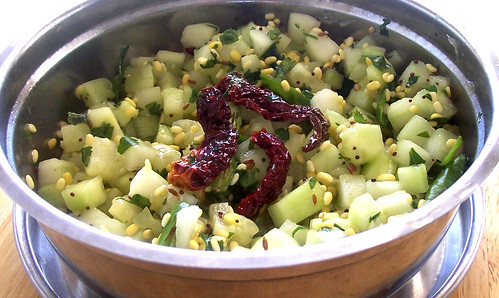
This is the first Indian dish I made when my husband and I were newly-married. It is a delicious and refreshing salad to serve in the summer or along side a spicy Indian meal. My mother-in-law, Kusum-tai, makes many variations using tomatoes, beets and even pomegranates. This version calls for cucumbers. Enjoy!

Koshimbir (Cucumber Raita)

Mix together 1 cup of chopped cucumber with 1 cup plain yogurt, (called daahi in Marathi and Hindi) Add salt and sugar to taste. Add 1 finely chopped serrano chili, some chopped cilantro (coriander) leaves and 1 TBSP peanut powder. (I use unsalted dry roasted peanuts, processed until a powder.)
Mix and chill.